Reay Road
Mafia Queens of MumbaiReay Road, a railway station and its surrounding neighborhood in Mumbai, is the setting for one of the book's most striking portraits of female criminal power. It is here that Jyoti Adiramalingam, known as Jyoti amma, rules as the reigning godmother of Sonapur Lane, a cramped warren of shanties that has become a nesting ground for crime and disease. The area's significance in the narrative is not merely geographical but symbolic: it is a place where the city's underbelly is laid bare, and where a woman's authority over life, death, and illicit commerce is absolute.
A Neighborhood Defined by Death and Gold
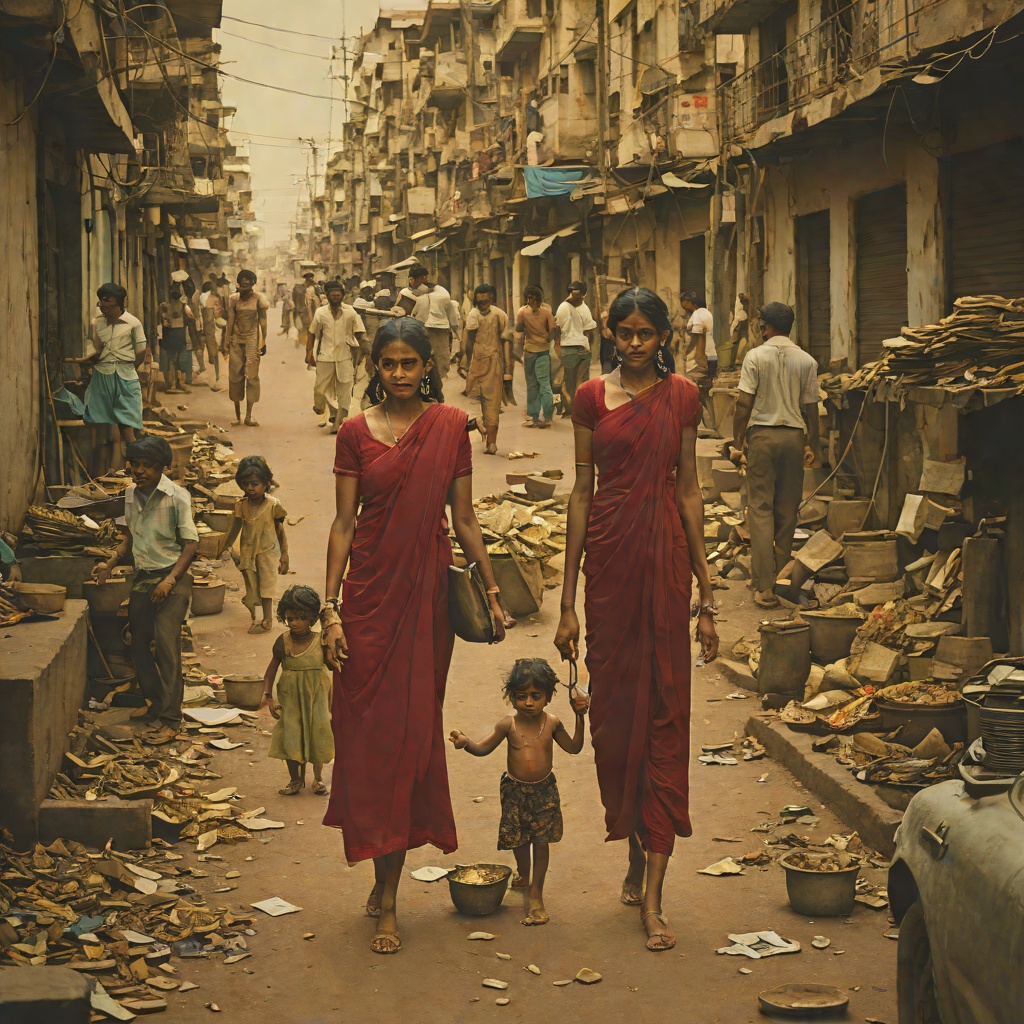
Sonapur Lane, also called Sonapur Galli, lies just a stone's throw from the Reay Road railway station. Some thousand shanties nestle here, a nesting ground for crime and disease. The name 'Sonapur' is deceptive: the 'sona' in Sonapur is in no way related to 'gold'; it, in fact, refers to 'death' or 'sleep', because of several Muslim graveyards in the vicinity. Yet for one woman in this otherwise nondescript residential hub of Mumbai's underbelly, the area did bring gold and untold wealth. This irony is central to understanding Reay Road's role in the book: a place named for death became the source of immense fortune for Jyoti, who laid down the rules and alone had the authority to bend them.
The area's grim character is reinforced by its proximity to other landmarks of mortality and colonial legacy. The nearby Bada Qabrastan, a sprawling 7.5-acre cemetery that is a hundred-and-fifty-years-old, abuts the Marine Lines station, and commuters cut across it before taking the stairs to the over-bridge. This juxtaposition of daily life and death is a recurring motif in the book's depiction of Mumbai's older neighborhoods. Reay Road, like Marine Lines, is a product of the British legacy that put Mumbai on the trade route in the mid-nineteenth century, linking the city with an amazing network of railheads. The railway itself is a constant presence: during a tense interview with Jyoti, the unnerving silence was broken by the chugging of a train as it hurtled past the Reay Road railway station, a reminder of the city's relentless motion even in its most stagnant corners.
The Drug Baroness of Sonapur Lane
According to the dossiers of the Narcotics Control Bureau and the Anti-Narcotics Cell, Jyoti is one of the many small yet dominant cogs in the humongous machine of the Rs 1,000-crore drug trafficking industry in Mumbai. The forty-six-year-old is considered to be one of the most feared drug baronesses. Her rise was not solitary; she was lured into the trade by Savitri, a prominent drug peddler in the Sion-Koliwada slum, who also recruited Mahalaxmi Papamani. Under Savitri's tutelage, Jyoti and Papamani were given the responsibility of dividing large quantities of heroin into smaller pudis (packets) and distributing them to interested parties. This troika of women—Savitri, Papamani, and Jyoti—soon began to control the pudi-selling business in Sion-Koliwada, with profits running into lakhs.
Jyoti's power in Reay Road is depicted as absolute and unchallenged. She is the one who lays down the rules and she alone has the authority to bend them. This authority is not merely a matter of reputation; it is enforced through a network of fear and control that makes the area her personal fiefdom. The book's narrator, a journalist, found the encounter with Jyoti to be a difficult one. The journalist realized that while she had come to ferret information from Jyoti, Jyoti was subtly extracting information about her with a barrage of counter-questions. This reversal of power dynamics is a testament to Jyoti's shrewdness and her complete command over her territory.
A Hub of Illicit Commerce and Its Wider Context
Reay Road's significance extends beyond Jyoti's personal story. It is part of a larger geography of crime in Mumbai that the book maps with ethnographic precision. The area's transformation into a drug den is paralleled by other neighborhoods: the Sion-Koliwada slum, which became notorious under Mahalaxmi Papamani, and the older criminal economies of Dongri and Daana Bazaar, where Jenabai Daaruwali began her career as a broker for smuggled grain. These locations are not isolated; they are nodes in a network of illicit commerce that connects the city's poorest residents to its most powerful criminals.
The economic logic of this commerce is starkly illustrated in the book. Papamani's business strategy, for instance, involved buying five kilogrammes of heroin at anywhere between one to three lakh rupees and converting ten grams into forty pudis, selling each at twenty-five rupees, making a profit of around three lakh rupees per month—about the salary of a CEO of a company in Mumbai. This kind of profit margin explains why women like Jyoti and Papamani, often illiterate and from the most deprived backgrounds, were drawn to and dominated these trades. The book argues that for these women, crime was not only a way of transcending their poverty and limitations but also a life-saving concept.
The State's Response and the Limits of Law
Reay Road also serves as a stage for the state's often futile attempts to control the drug trade. The police tried to arrest Papamani on several occasions but she always managed to escape conviction, for want of evidence. This pattern of evasion is a recurring theme in the book, reflecting the difficulty of prosecuting criminals who operate with the tacit support of their communities and the fear of their neighbors. The legal framework itself is shown to be inadequate: MCOCA, a stringent law promulgated by the Maharashtra government in 1998 after the abrogation of the TADA, was formulated because the state did not have any firm law with which to fight organized crime. Yet even this draconian legislation often failed to bring down figures like Jyoti.
The book's treatment of Reay Road is part of its broader project to understand the complex minds and psyche of women criminals. It is in no way meant to glorify them, but it insists that these women were not blank slates written upon by dangerous male mafia members. Jyoti's story, set against the backdrop of Sonapur Lane, exemplifies this: she is a woman who carved out a domain of power in a space marked by death, turning the very name of her neighborhood into a source of wealth. Her authority, her shrewdness, and her ability to outmaneuver both the police and her own mentor make her one of the book's most compelling figures, and Reay Road is inseparable from her legend.